| Drone | Sessions | Observers | Observations | Smallest angle (′) | Largest angle (′) |
|---|---|---|---|---|---|
| DJI Mini 2 | 8 | 5 | 4,476 | 0.7 | 5.0 |
| Autel EVO II Pro V3 | 9 | 4 | 4,599 | 1.0 | 9.3 |
| DJI Inspire 2 | 11 | 5 | 6,484 | 1.6 | 12.7 |
| eBee | 4 | 4 | 3,202 | 1.7 | 355.5 |
Experiment
Field trials testing whether the estimator’s angular-size model predicts when observers can see a drone.
Purpose
The VLOS estimator predicts how far away a drone stays visible, based on its angular size: how large it appears to the observer. These trials test that prediction directly.
Method
Drones
Four drones were flown, ranging from a 249 g quadcopter to a fixed-wing mapping aircraft. Dimensions were measured on each aircraft.
| Drone | Type | Width (in) | Height (in) |
|---|---|---|---|
| DJI Mini 2 | Multirotor | 8.5 | 3.1 |
| Autel EVO II Pro V3 | Multirotor | 15.2 | 4.4 |
| DJI Inspire 2 | Multirotor | 16.7 | 12.2 |
| eBee | Fixed-wing | 45.7 | 5.5 |
Flights and observers
The multirotor trials were flown between June 11 and June 20, 2025. 8 observers took part, with experience ranging from beginner to experienced pilot. Several observers watched the same flights at the same time, giving 32 observer sessions in total. Each observer recorded whether they could see the drone, and those records were matched to the drone’s flight log by time.
Angular size
Each observation’s angular size was computed from the drone’s horizontal distance and altitude relative to the observer, using the same model as the estimator. The model treats the drone as seen from the side, so it is a conservative measure: it describes a drone flying straight toward or away from the observer. See How the estimate works.
Measurement accuracy
Angular size depends on distance, so errors matter in proportion to how far away the drone is: a distance error of ΔR changes the angle by about ΔR ÷ R.
GPS positions from consumer drones and phones are typically accurate to a few meters, which is small compared with the hundreds of feet at which drones were lost.
Timing is the larger risk. Devices were synchronized manually before each flight and checked against https://www.time.gov/. A 3-second error at 25 ft/s shifts the drone’s position by up to 75 ft. Observers typically lost sight of the drone about 830 ft away, so that error would change the angle by roughly 9%, and only if the drone was flying straight toward or away from the observer.
Results
All drones together
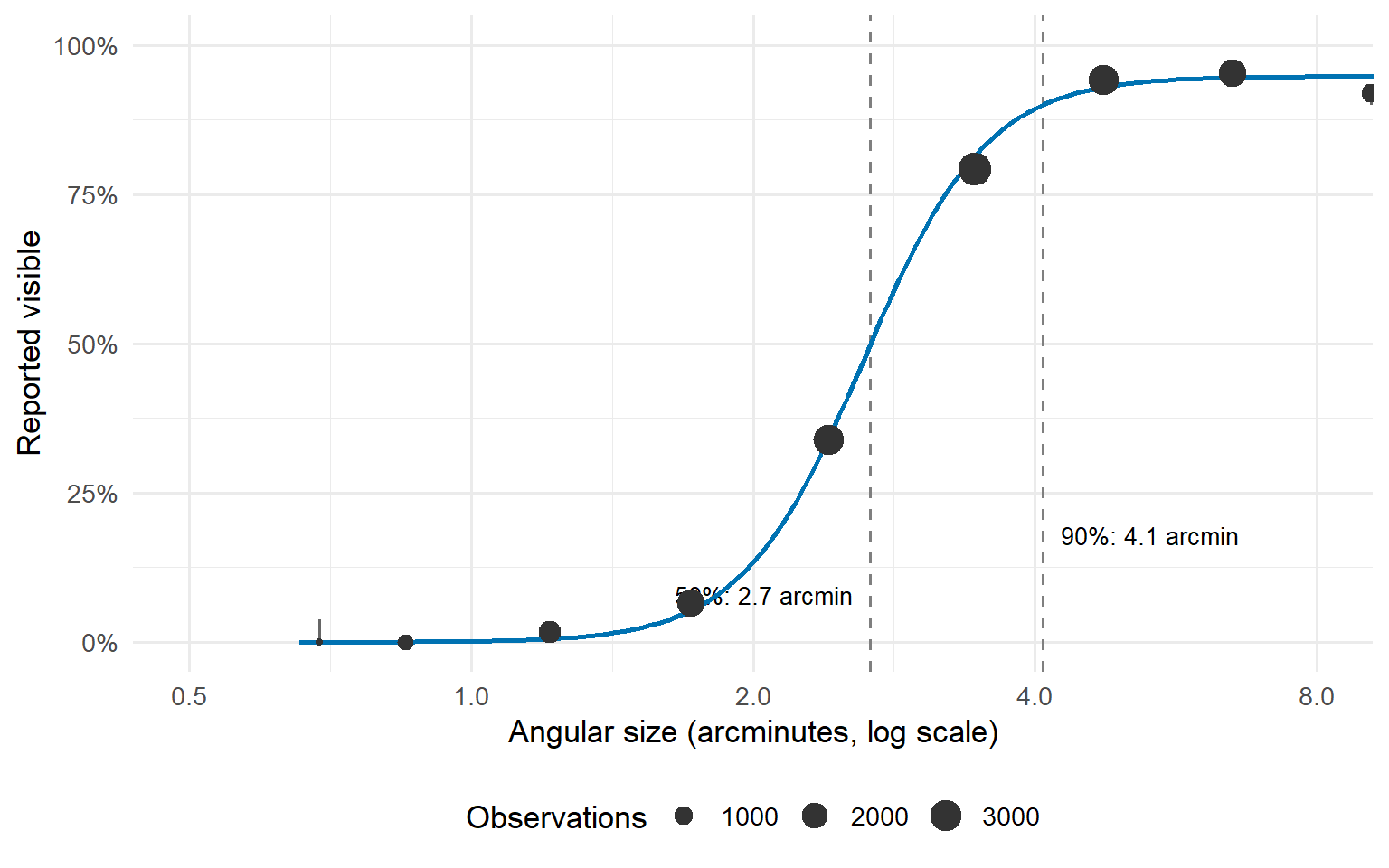
Across all four drones, visibility crosses 50% at about 2.7′ and reaches 90% at about 4.1′. Below 1′, observers reported the drone visible in 0 of 792 observations. The smallest angle in the data is 0.65′, so the data says nothing about smaller angles.
Even at large angles, visibility levels off at about 95% rather than 100%: some sightings were missed for reasons unrelated to size.
Drone by drone
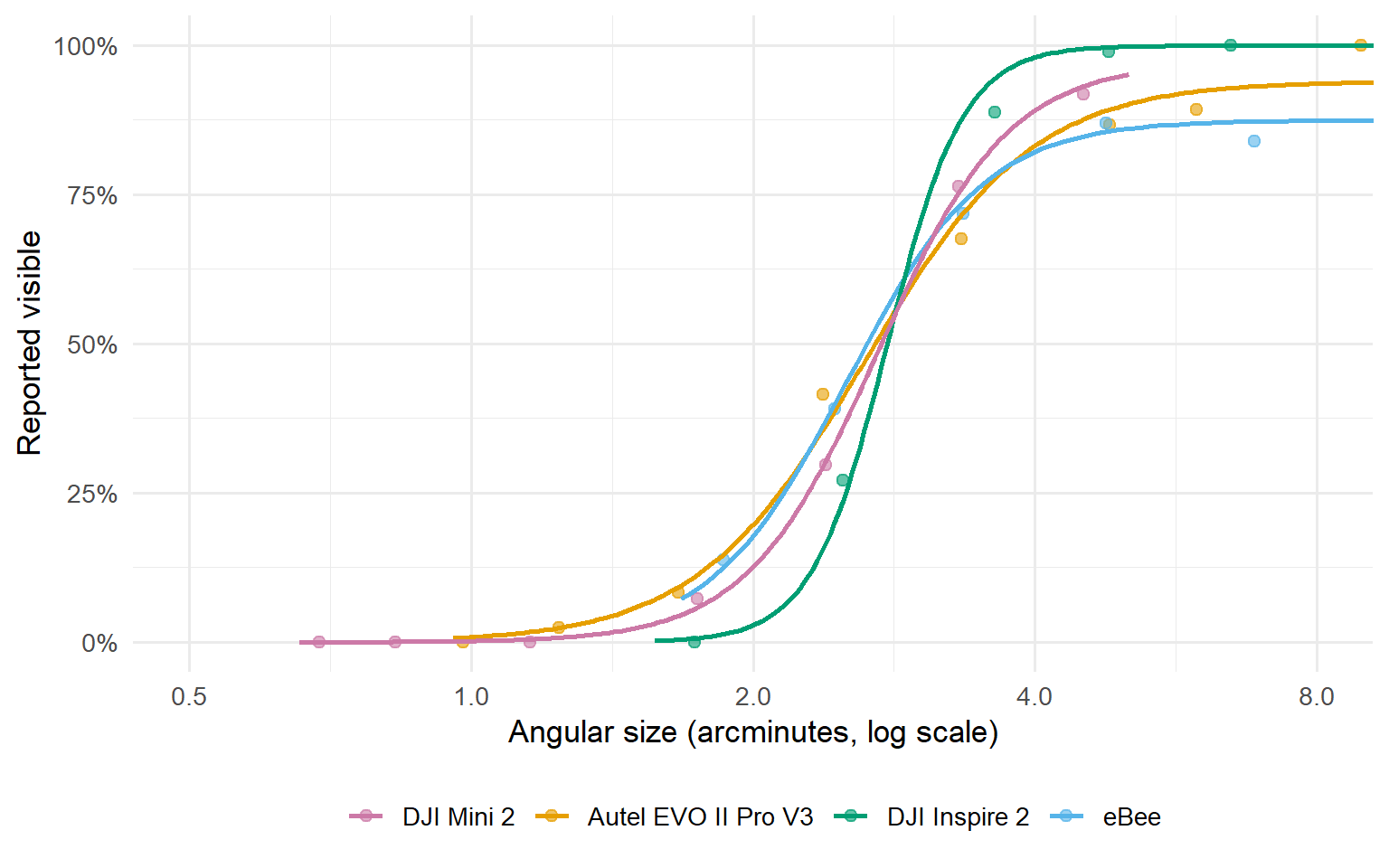
| Drone | 50% visible (′) | 90% visible (′) | Missed at large angles |
|---|---|---|---|
| DJI Mini 2 | 2.7 | 4.1 | 3% |
| Autel EVO II Pro V3 | 2.7 | 5.0 | 6% |
| DJI Inspire 2 | 2.8 | 3.4 | 0% |
| eBee | 2.6 | not reached | 13% |
The 50% points fall within a narrow range, from 2.6′ to 2.8′.
Losing and regaining sight
Each change in an observer’s response marks a moment when they lost or regained sight of the drone. There are 280 such moments in the data.
| Drone | Times lost | Median angle when lost (′) | Median angle when reacquired (′) |
|---|---|---|---|
| DJI Mini 2 | 48 | 2.3 | 3.2 |
| Autel EVO II Pro V3 | 23 | 2.0 | 2.7 |
| DJI Inspire 2 | 21 | 2.8 | 3.2 |
| eBee | 46 | 7.0 | 12.8 |
For every drone, observers needed a larger angle to find the drone again than to keep tracking it. Once a drone is lost, it has to come closer before it can be found again. Pilots who look away at a controller screen should expect the same.